► BASIC OP AMP MODEL - Level 1
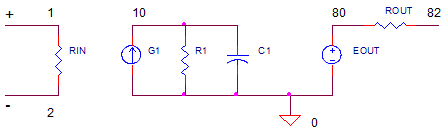
You've probably seen op amps in a variety of applications, but how do you simulate them? Here's a good place to start - the three basic stages of an op amp: 1) Differential Amplifier, 2) Gain / Frequency Response and 3 ) Output Buffer. Using basic SPICE devices, this model helps you simulate the frequency response and DC accuracy of your amplifier.
|
|
|
► INTERMEDIATE MODEL - Level 2
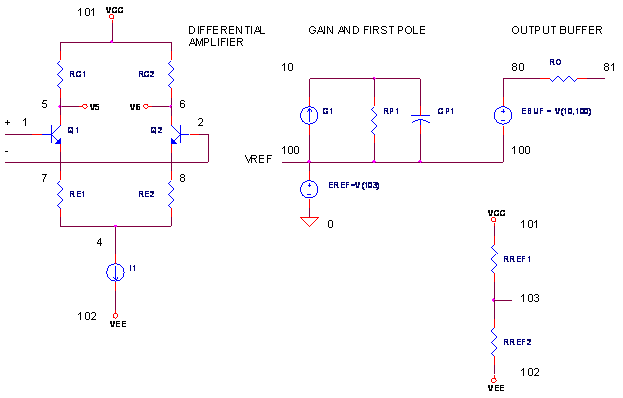
This SPICE model (Boyle type) looks similar to ones created by many op amp manufacturers using a transistor front-end. Only slightly more complex than the basic op amp, it models several key behaviors including slew rate limiting.
Another main benefit is that many advanced behaviors - voltage and current limit, CMR behavior, additional poles and zeros - can be easily added to this model (see Level 3 model below.) You can download an Excel spreadsheet that calculates the component values given an op amp's specifications.
|
|
|
CHECK IT OUT! Optional methods for creating Gain, Pole and Slew Rate behaviors without a transistor front-end.
► ADVANCED COMPONENTS - Level 3
Learn to model advanced analog behaviors with the Level 3 Op Amp models. Each SPICE file below adds an advanced function - one at a time - to the Level 2 Op Amp Model. Take the functions you need, modify them if you like, or create your own op amp model.
|
|
► EASY-TO-USE FUNCTIONS
Here are some alternative - and typically simpler - ways to implement various op amp functions.
OP AMP MODEL SUMMARY
| Model | Level 1 | Level 2 | Level 3 | |
| Differential Input | √ | √ | √ | |
|
Open-Loop Gain |
√ | √ | √ | |
| 1st Pole (Frequency Response) |
√ | √ | √ | |
| Output Impedance | √ | √ | √ | |
| Slew-Rate Limit | √ | √ | ||
| Internal Floating Nodes | √ | √ | ||
| Additional Frequency Shaping Stages | √ | |||
| Correct Supply Rail Currents | √ | |||
| Output Voltage and Current Limit | √ | |||
| Input Offset Voltage | √ | |||
| CMR Frequency Response | √ |
LTSPICE OP AMP MODELS
Solve 10 Op Amp Design Issues using Custom LTSPICE MODELS.
© 2007-2025 eCircuit Center